A place for the context behind your life.

Dorima keeps your journal, projects, tasks, people, calendar and decisions together.

That means when you use AI inside Dorima, it can work from what you've already written instead of asking you to explain everything again.

Opening to a first cohort this fall.

One record, used a few different ways.

You put things into Dorima by typing, talking, journaling, adding a task or connecting your calendar. Dorima keeps that information together. Every screen is a view of it, and every AI feature reads the same context, so the advisor, the scenario and the morning paragraph are looking at the same record.

That same context can then be used to plan the day, remember projects and commitments, read a journal entry back to you, ask several advisors the same question, think through a scenario, notice patterns across weeks, keep track of people and important dates, and give you a short summary of yesterday. It can also carry on a chat that already knows what you are working on, finish a habit by writing a few lines, and keep a shelf of books and essays chosen from what you write about.

You shouldn't have to organize the same information over and over.

you put in
  • journal entries
  • tasks and projects
  • habits
  • calendar
  • people
  • directions
  • attachments
one record
  • append-only
  • encrypted per user
  • isolated per account
context, assembled by code
  • your recent entries, and whatever is closest to what you asked
  • summaries of the weeks behind them
  • which people, which dates
  • what you said you were aiming at
it reads back
  • a paragraph each morning
  • a narrative each week
  • a read on an entry
  • advisors, one question at a time
  • scenarios, and what would prove each wrong
  • the compass
  • a reading shelf

The model writes. It does not decide what is relevant, and it does not act on your behalf.
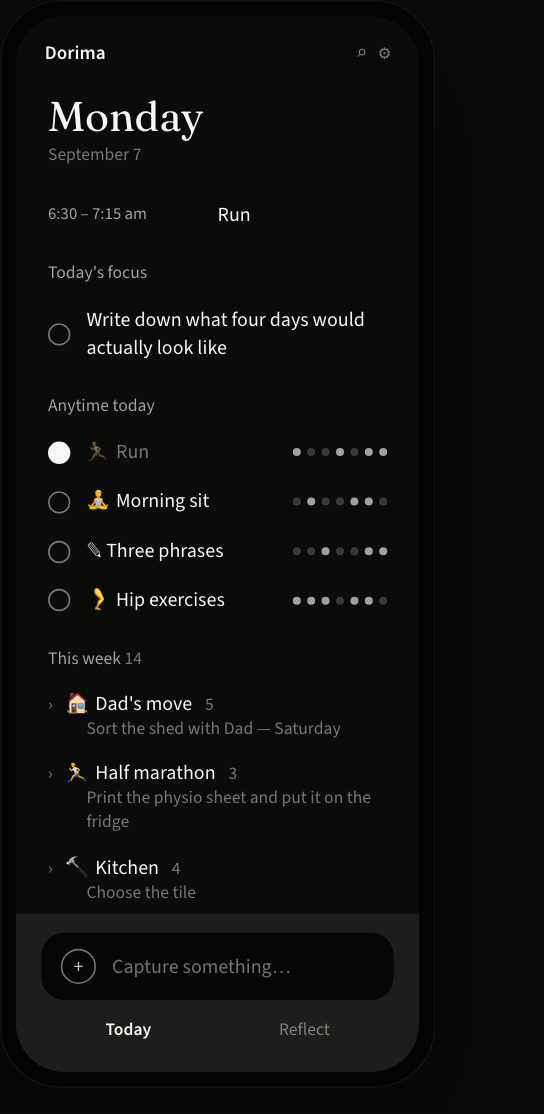
A normal day in Dorima.

The six screens, with fixture data, in roughly the order of a day.

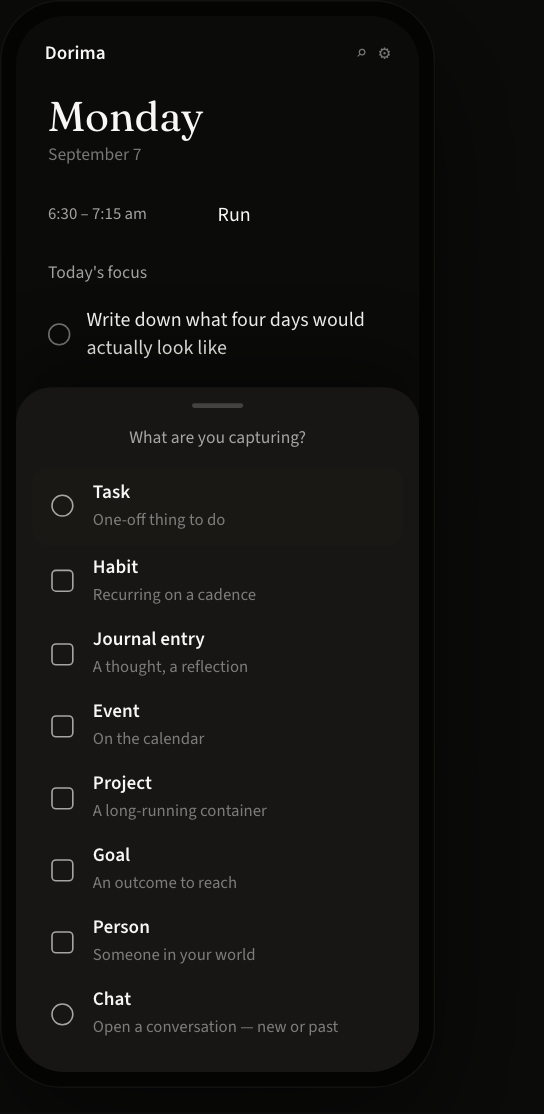
Capture sheet: what are you capturing, filed as the right kind

Capture. Type or say something. Dorima works out whether it's a task, event, project, person or note, and you choose when it can't tell.

Today: the day on one screen

Today. Your calendar, habits and the things that actually need attention today. Habits show a pattern, not a streak.

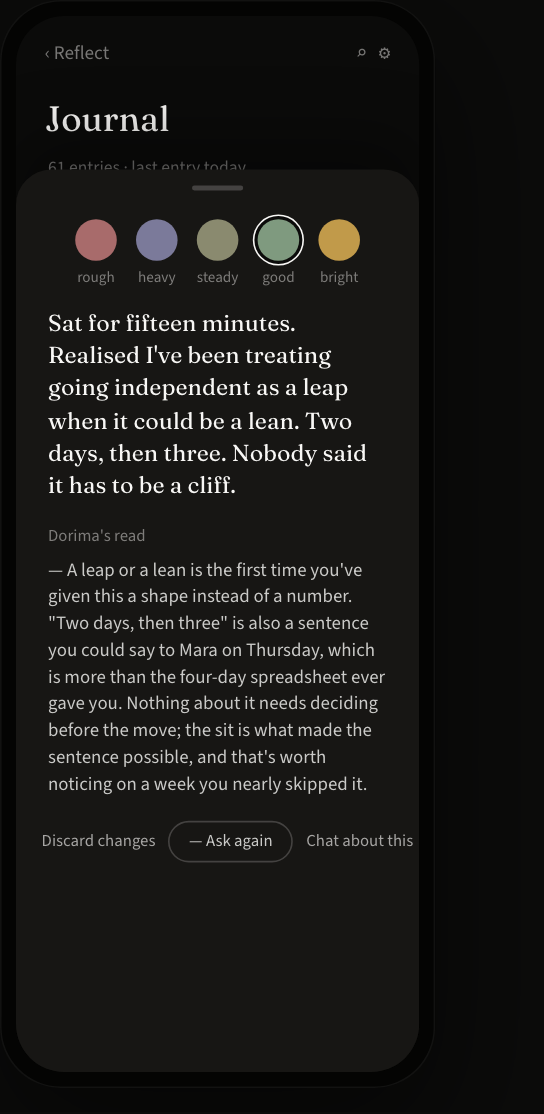
Journal entry with the read Dorima wrote back

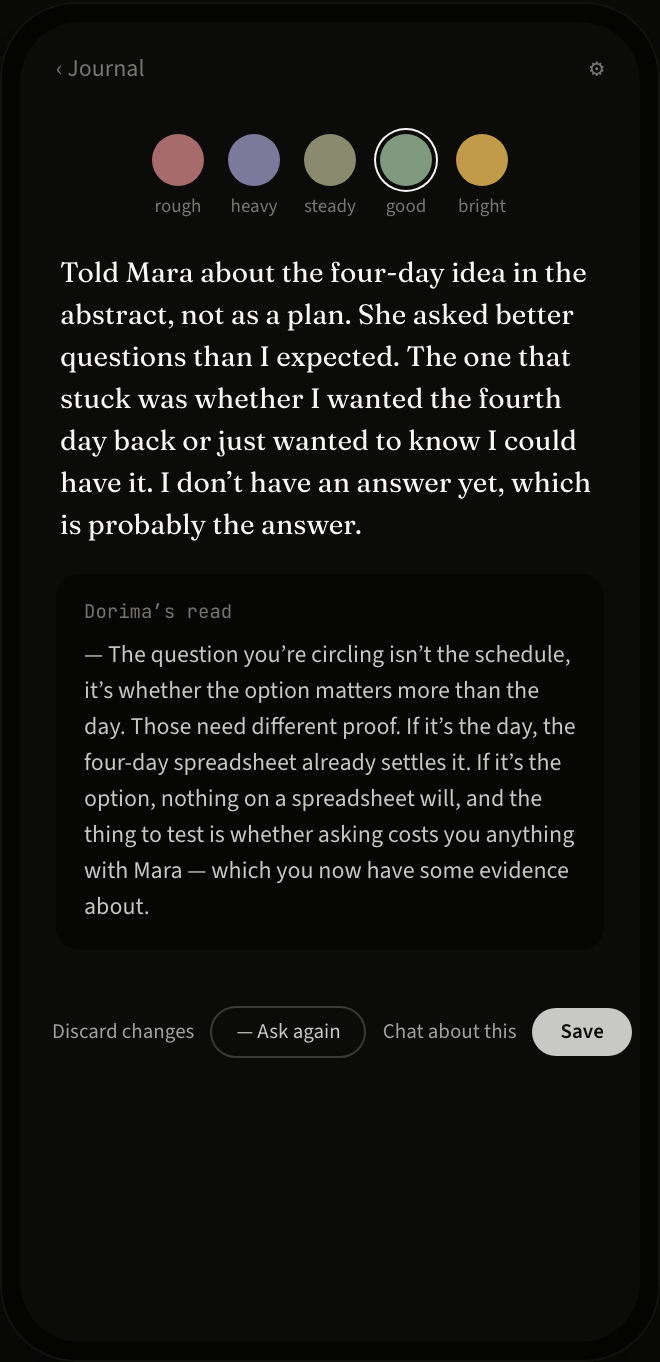
Journal. Write a few sentences and pick a mood. Dorima reads the entry back and helps you think about it.

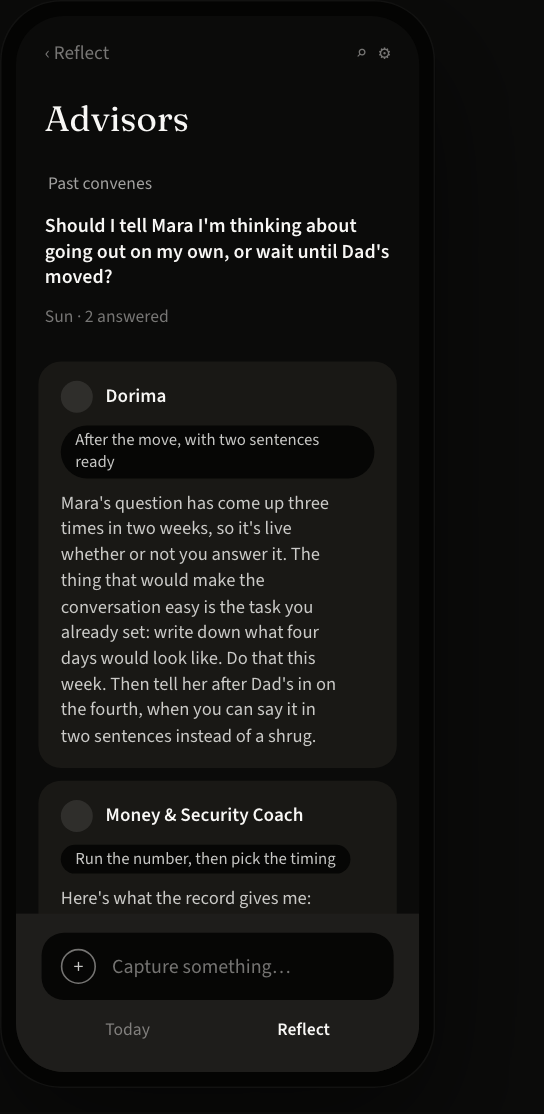
Advisors: one question, every advisor answers in its own voice

Advisors. One question, several answers. Nothing merges them for you.

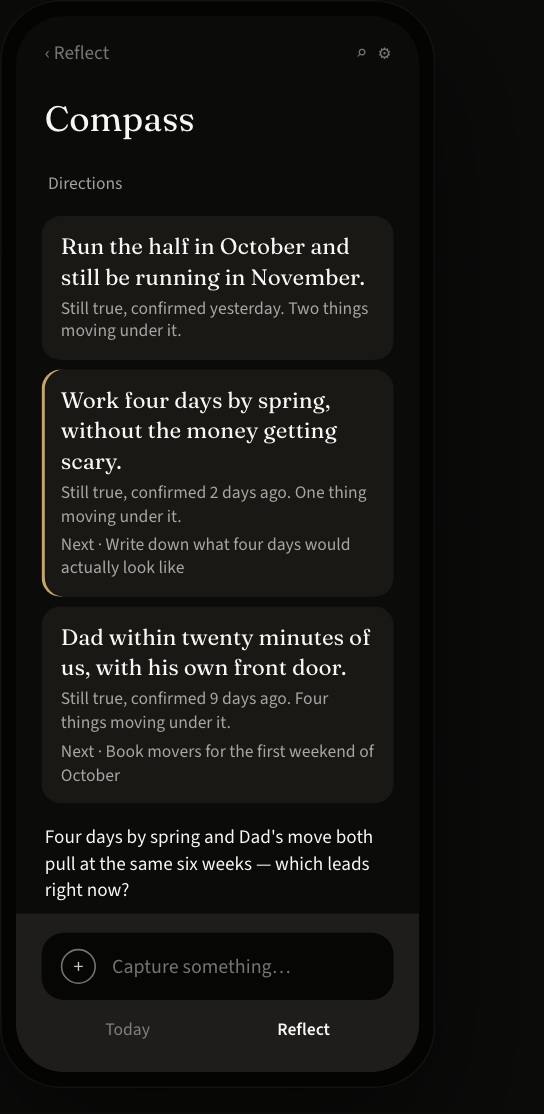
Compass: the directions you named, and what is moving under them

Compass. A few directions you said mattered, each with how long since you last meant it.

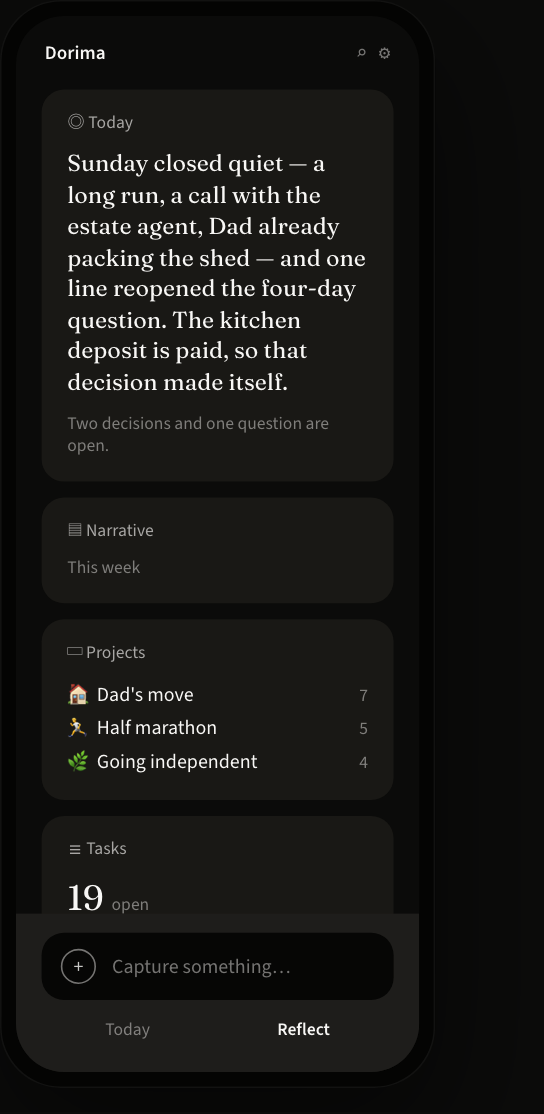
Reflect: the morning paragraph and the shelf of everything else

Reflect. Look back across yesterday, the week, and the things you've been writing about.

scroll sideways →

The morning paragraph says what happened yesterday and whether anything needs deciding today, then stops. Most mornings the answer is nothing. When it starts keeping score instead, that is treated as a bug.

Wednesday: physio at half three, nothing else booked. Dad's move is a two-week window, not a today problem. Nothing needs deciding.a morning paragraph, fixture data

The journal is the center of it.

Dorima started as a journal. A few sentences about what happened, what you were thinking about and what mattered that day turn out to be more useful than a complicated productivity system.

Over time, those small entries also give AI something most chats don't have: continuity. A project mentioned three weeks ago can still matter today. So can a person, a decision, a worry or something you said you wanted to change.

Dorima tries to keep that thread without turning your life into a scoreboard. The bet is that a small habit you keep beats a larger one you don't. That is a bet, not a finding.

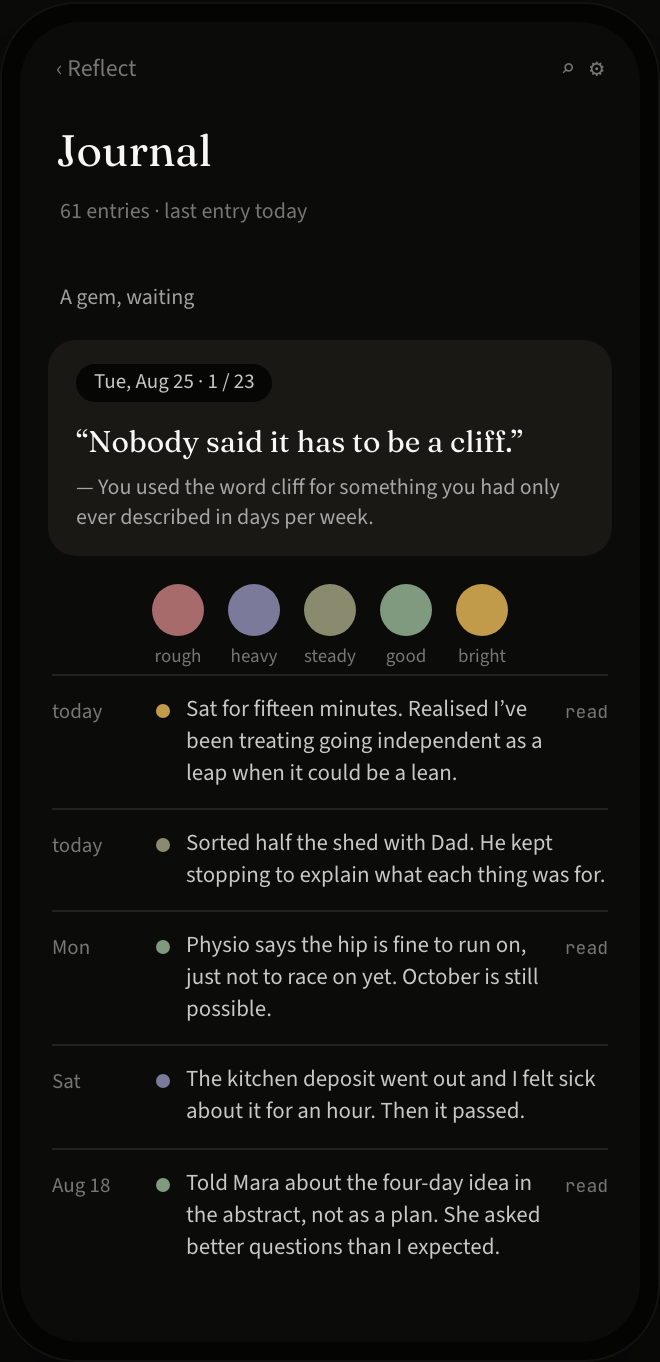
→ the journal: a few sentences, a mood you pick yourself, a prompt only if you ask for one
Journal list: recent entries, each with a mood, and a gem waiting at the top

Your journal. A few sentences and a mood you pick yourself, newest first. A gem waits at the top until you keep it or let it go.

A journal entry open, with Dorima's read below it

The read. Dorima reads the entry back and says what it sees. One reflection, then it stops.

What it does not do.

Dorima doesn't act on your behalf. It doesn't make decisions for you, try to keep you engaged, or turn everything into a notification. There are no streaks, no badges, no red dots, no feed, no sharing and no ads.

Sometimes the useful answer is that nothing needs your attention, and Dorima says so.

Your data.

You can see what Dorima holds about you: every journal entry, task, goal, and the notes its advisors keep. Tasks, projects and journal entries you can edit. What you capture or say in chat is kept as written, and you can delete it.

Each account is encrypted per user. Neither AI provider trains on your data: Anthropic's commercial terms prohibit it, and Dorima does not opt in to OpenAI's training. You can pause AI processing, download the data included in Dorima's export tool, or delete the account from settings. There is no analytics on your behaviour and no social layer.

Notebook drawingPencil drawingThe paint brush of mistakes

Why Dorima exists.

Most tools for this either want to organize you or want your attention. Dorima is built on the idea that a person's own record, kept plainly and read back honestly, is worth more than either.

It is small on purpose. It is independent, it is not funded by advertising, and it has no reason to keep you on a screen. When something can be settled without it, it says so and gets out of the way.

It is built and run by one person, and that shapes what it does: no growth targets, no engagement metrics, and a short list of things it refuses to do.

Want to try it?

People are being let into Dorima gradually, while the rough edges get worked out. Leave your name and email and you'll get an invite when a place opens.